The words full arch sound like they describe a set of teeth. They mostly describe a foundation, and the teeth show up at the end of the story. Once that clicked, most of what I found confusing about implant dentures stopped being confusing.
I asked a couple of dentists near me to explain the part the brochures skip, and Hillsboro Dental Excellence walked me through what gets settled long before anybody picks a tooth shade. The arch you end up wearing is a consequence of whatever is holding it up.
Hold onto that word. Holding. I keep coming back to it because everything below is a variation on it.
What is actually underneath the teeth
A removable denture sits on your gums. That is the entire mechanism.
It presses against soft tissue, it is shaped to trap a bit of suction, and when the fit is good it stays put well enough to get you through dinner.
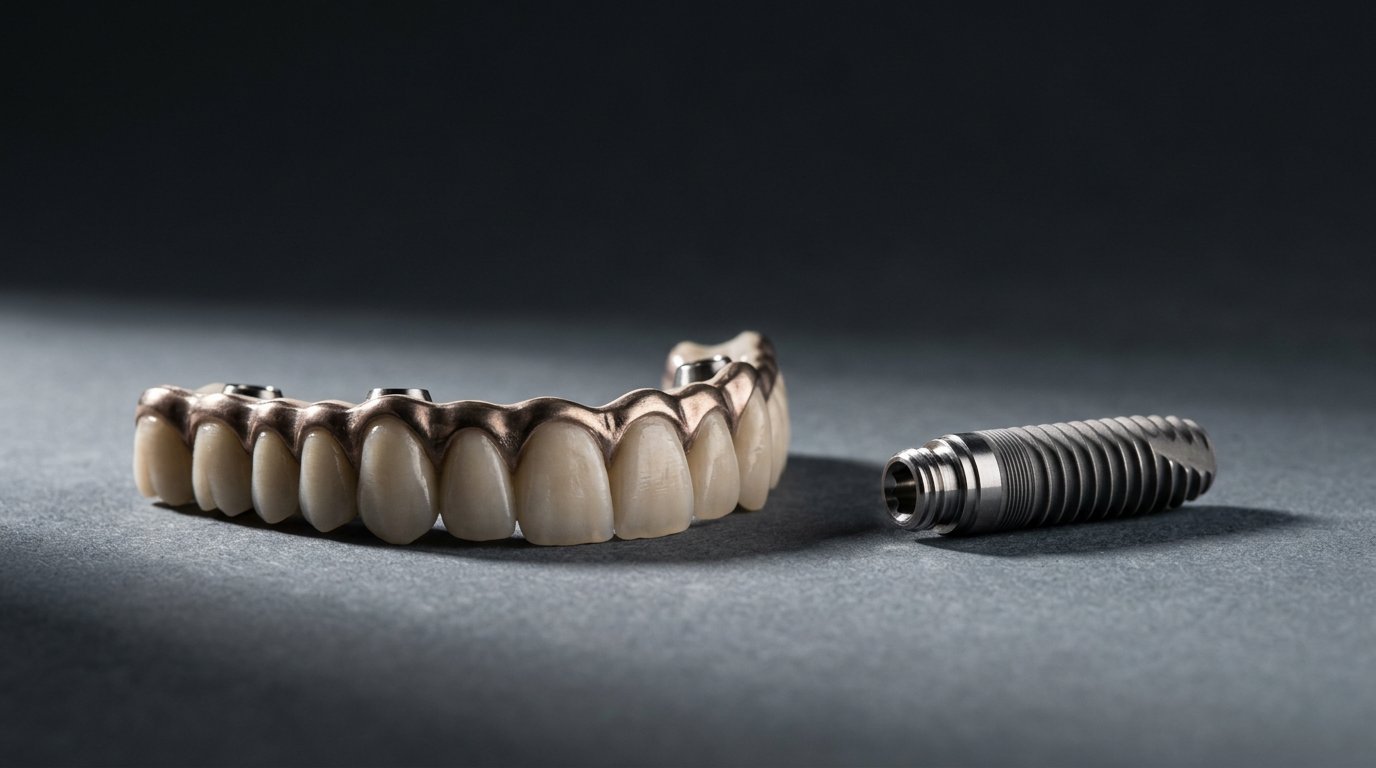
A fixed arch stops using the gums as a load-bearing surface. Titanium posts go into the jawbone, the bone grows tight against them, and a bridge of teeth is fastened to those posts. The All-on-4 approach is the version of this most people have heard of, where a small number of posts are angled to catch the densest bone available and carry the whole arch.
Resting and anchoring are different jobs
A denture that rests has to spread its weight over as much tissue as it can reach, which is why the upper ones are so broad and why they cover so much of the roof of your mouth. That coverage is doing structural work. Take it away and the thing rocks.
An anchored arch does not need the coverage, because the bone is doing the work instead. So the appliance can be slimmer, the palate can be left open, and the whole object gets smaller.
Which is a comfort question until you eat something. Then it becomes a force question.
The bone decides what is possible
Here is the loop again, one layer down. If bone is what holds the arch, then the first real conversation is about your bone, not about your teeth.
That is why the workup leads with imaging.
Digital images and x-rays get taken so that any lingering infection or loss of bone density turns up before a plan exists, and the gums get examined for periodontal disease while they are at it. None of that is about how the teeth will look. It is a survey of what is available to build on.
Thin bone changes the plan rather than ending it
I assumed a bad scan meant a no. It usually means a different plan. Fixed implant dentures are available to most patients, including cases where a graft is needed first to build up enough bone to hold the posts. The bone gets brought up to what the design requires, and then the design proceeds.
The reason the All-on-4 angling exists at all is this same constraint. Tilting the back posts lets them reach bone that is still solid, so the arch can be supported without adding hardware into places where there is not much left to grab.
Force goes somewhere different now
Third pass at holding, and this one is the pass that made me understand why people describe the change as dramatic.
Chewing force has to be absorbed. In a removable denture, it lands on gum tissue that was never built to take it, which is why sore spots are a normal part of denture life and why so many people quietly stop eating anything that requires real pressure. The tissue is the shock absorber, and it is not a good one.
With a fixed arch, the force travels through the bridge, into the posts, into the bone. Bone is the tissue that was designed for load. It responds to being used.
What actually changes at the table
Adhesive stops being part of the routine, because nothing is being glued to anything. The arch does not slide when you bite into something firm, and it does not come out when you are done.
Foods that a denture wearer learns to avoid come back onto the table.
Maintenance gets simpler in the same stroke. There is no soaking cup on the counter and nothing that has to come out of your face.
I want to be careful here, because the marketing around this stuff oversells the emotional part and undersells the mechanical part. The mechanical part is the whole story. It bites like teeth because it is loaded like teeth.
The part of the face nobody warns you about
Now the layer that surprised me most.
Teeth do more than chew. They hold your lips and cheeks out to where they are supposed to sit. When an arch of teeth is missing, or when a denture is worn that is thinner than the bone it replaced, the lips start to curl inward and the cheeks lose their support and begin to sag. The wrinkling that follows gets blamed on age when a fair amount of it is architectural.
A full set of teeth that is properly positioned puts that scaffolding back. The arch is shaped not only to look right head-on but to push the soft tissue back out to where it used to live.
That is a design decision, and it gets made by whoever is planning your case. Which loops back, again, to the survey at the beginning. The plan knows what your face is supposed to look like because somebody measured for it.
What the process asks of you
There is a sequence to this, and it is not a quick errand.
There is a consultation where the imaging happens and a plan is written. There is a surgical visit where the posts go in. There is a provisional bridge in most cases, so you are not walking around with nothing while the bone integrates around the titanium. Then there is the final arch, made once the foundation has proven itself.
The healing is the part that cannot be rushed, and any plan that pretends otherwise is selling something. Bone locks onto titanium at the pace bone works at. Every honest version of this treatment respects that.
General health is part of the plan
The approach works best in patients whose overall health supports healing, which is a sentence that sounds like a disclaimer and is actually a design input. Healing is the mechanism the entire arch depends on. If something is interfering with it, that gets addressed as part of the case rather than discovered afterward.
Bringing it back to the word
So. Holding.
A removable denture is held down, against tissue, by fit and suction and adhesive, and everything annoying about it descends from that. A fixed arch is held up, from inside the bone, and everything good about it descends from that. Comfort, bite force, the slimmer shape, the face keeping its structure, the fact that you stop thinking about your teeth as an object you own and start thinking about them as a part of you again.
The teeth are the last decision anybody makes. They are also the only part you see, which is why it took me this long to notice they were never the point.
If you are weighing this, the question that gets you somewhere is what you have to build on, and what the plan intends to do about the answer.