Plumbing prices in Knoxville don’t follow the rule of thumb most homeowners assume. The number on the invoice usually traces back to three things the customer didn’t see: how the trip was scheduled, what was actually wrong with the fixture, and whether the house has a quirk that turned a 30-minute job into a 90-minute job. Sticker shock isn’t really sticker shock once those variables are visible.
Sanders Plumbing Company answers Knoxville service calls across Sequoyah Hills, Powell, Halls, and most of Knox County. When a homeowner wants a number before the truck rolls, Sanders Plumbing Company is the Knoxville Plumber most folks reach for. The cost ranges below reflect what the actual repair tickets look like for typical Knoxville housing stock, not a manufacturer’s published price guide.
What “common repairs” actually means
Before the numbers, a definition. “Common” Knoxville plumbing repairs are the calls that come in five to ten times a week at any local shop. They include:
- Toilet repairs (running, leaking, replacement)
- Faucet repairs and replacements (kitchen, bathroom, tub)
- Drain clearing (sinks, tubs, main line)
- Water heater service (sediment flush, thermostat, replacement)
- Garbage disposal jam or replacement
- Hose bib replacement
- Water shut-off valve replacement
- Visible supply line leak repair
These eight categories cover roughly 80% of the residential plumbing volume in Knoxville. Specialty work (sewer line replacement, repipes, fixture installations on remodels) is its own pricing world and doesn’t live in this article.
Toilet repairs and replacement: $125 to $650
A toilet that runs constantly is usually a flapper or fill valve. Parts run $15 to $40 retail. Labor for a Knoxville plumber to swap both is 30 to 45 minutes on the truck. A typical service call invoice for a basic running-toilet fix runs $125 to $185 once trip charge and parts are included.
A leaking toilet base is a different conversation. The wax ring needs replacement, which means pulling the toilet, which means inspecting the flange. Old Knoxville homes (anything pre-1970) often have cast-iron flanges that have rusted thin or cracked. If the plumber gets the toilet off and finds a bad flange, the job goes from $200 to $400 once a flange repair kit goes in.
Toilet replacement (homeowner buys the toilet, plumber installs) runs $200 to $325 for a standard install, more if the rough-in dimension is non-standard or if the supply stop needs replacement at the same time.
A surprise that catches Knoxville homeowners: in older homes with original cast-iron drain stacks, removing a toilet can stress the joint at the closet flange, which can crack the cast iron at the joint. That turns a $200 toilet swap into a $600 to $1,200 cast-iron repair. It doesn’t happen on every old toilet pull, but it’s common enough that a careful plumber will mention the possibility before quoting a flat price.
Faucet repairs and replacements: $150 to $450
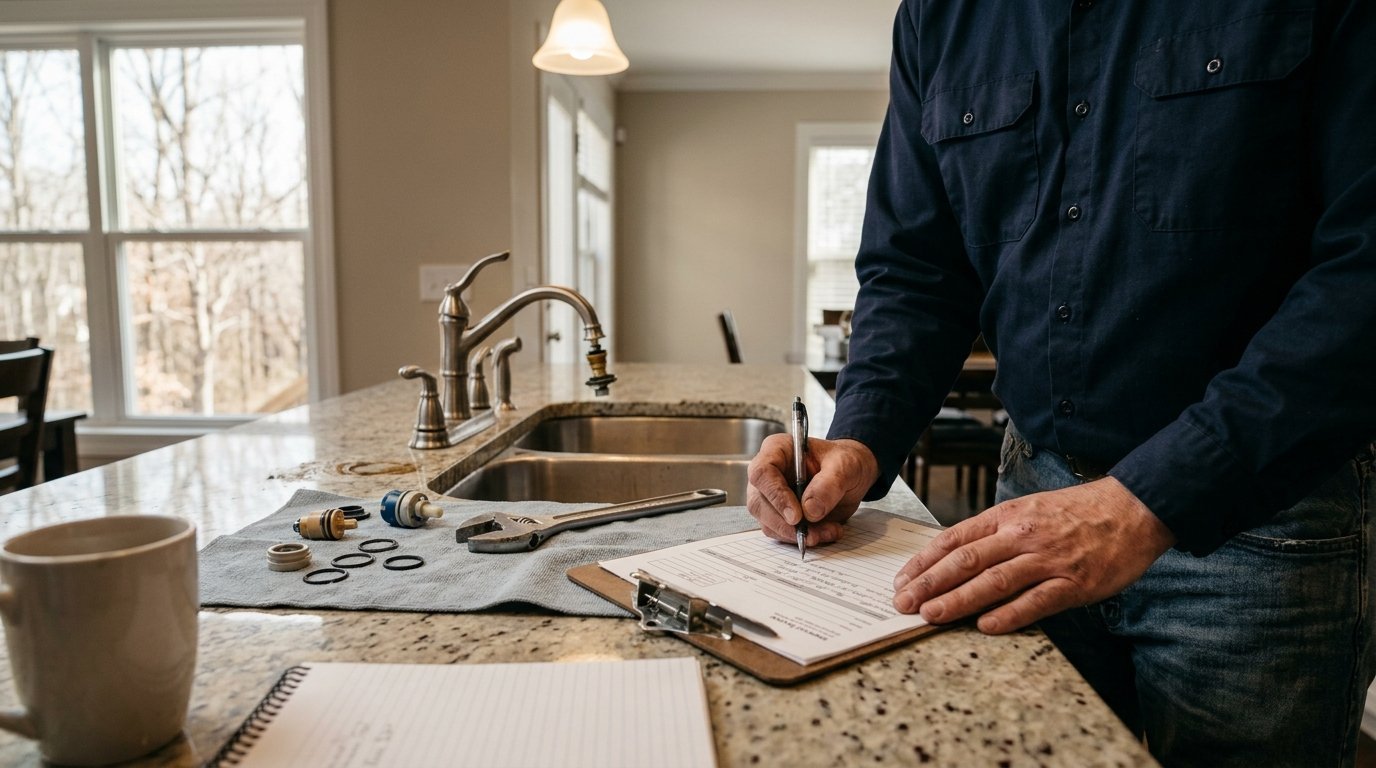
A leaking kitchen or bathroom faucet is usually a cartridge or a set of O-rings. Parts run $25 to $90 depending on the brand. Labor is 30 minutes to an hour. A repair call typically invoices at $150 to $225.
Faucet replacement is more variable. Big-box-brand faucets (Delta, Moen, Pfister) have standardized supply line connections and usually swap in 60 to 90 minutes, billing $200 to $325. High-end European brands or older imports often have non-standard supply or mounting hardware, which can push the install to two hours and $400 to $450.
Tub and shower faucets are a separate category. Single-handle tub valve replacement (where access exists from behind the wall) runs $250 to $450. If access requires opening a tile wall, the cost jumps because tile work is now in scope, and that’s a tile contractor’s bill rather than the plumber’s. The tile portion is often more than the plumbing labor itself.
Drain clearing: $175 to $475
A clogged kitchen sink that clears with a hand snake from the trap is usually a $150 to $200 call. The plumber pulls the trap, runs a snake 10 to 15 feet, clears the soap-and-grease blockage, reassembles. 45 minutes on the truck.
A clogged tub or shower drain often requires a longer auger because the blockage is past the trap. Hair clogs in bathroom drains are common in homes with multiple long-haired residents, and the cable on a small machine usually clears them. $175 to $250.
Main line clearing is the expensive end. If the kitchen sink, multiple bathroom drains, or the toilet are all backing up, the blockage is in the main building drain or the lateral to the city sewer. A cable machine (“rooter”) on a Knoxville main line runs $300 to $475, depending on cleanout access and how far the blockage is from the cleanout. If a cable doesn’t clear it, the next step is a hydro-jet or a camera inspection, which adds $250 to $500 on top.
Water heater service: $185 to $2,200
This category has the widest range because the work spans simple maintenance to full unit replacement.
A sediment flush on a tank water heater that’s still functioning runs $185 to $275. Most Knoxville water heaters need this every 18 to 24 months because of moderate hardness in the local water supply. Skipping it shortens the unit’s life, but it’s not an emergency repair.
A thermostat or heating element replacement on an electric tank runs $225 to $350 in labor and parts, depending on whether the upper or lower element is the failed one (or both).
A gas water heater pilot or thermocouple replacement runs $200 to $325, sometimes higher if the gas valve assembly has failed and needs replacement.
Water heater replacement is the big number. A like-for-like swap of a 40 or 50 gallon tank gas water heater, with permit pulled and seismic strapping installed (Seattle requires this; Knoxville doesn’t, though some inspectors recommend it on slab homes), runs $1,400 to $1,900 installed. An electric tank swap runs $1,200 to $1,700. Tankless installations are a different conversation that lives in its own article. Those run $3,500 to $6,500 once gas line and venting work is factored in.
Garbage disposal: $185 to $385
A jammed disposal that clears with a manual unjam from the bottom is a $150 to $185 call, sometimes less if the plumber is already on-site for another item.
A disposal that’s leaking from the bottom housing means the unit has rusted through. Replacement disposal units run $130 to $300 retail (the homeowner usually buys the unit at a big-box store) and labor to swap is 45 minutes to 90 minutes, billing $200 to $300.
A surprise: disposals that are leaking from the top (where the unit meets the sink basket) are usually a flange seal failure, not a disposal failure. That’s a $175 to $250 repair, much cheaper than full replacement, but the visual symptom is identical to the homeowner. A plumber who diagnoses this correctly saves the customer $200.
Hose bib replacement: $225 to $400
Outdoor hose bibs in Knoxville have a freeze failure pattern. Freezing water expands inside the bib, splits the brass, and the leak shows up the next time the homeowner turns it on after a hard freeze.
A standard hose bib replacement is $225 to $325 if the connection inside the wall is accessible and not corroded. If the bib is threaded into an old galvanized supply stub-out that has rusted to the bib, the plumber may need to cut the supply line behind the wall and add a new section, which pushes the cost to $350 to $400.
Frost-free hose bibs (recommended for any Knoxville home that doesn’t shut off and drain its outdoor lines before freezing weather) cost more in parts ($45 to $90 vs $15 to $25 for a standard bib) but the install labor is similar. Total bill on a frost-free swap runs $275 to $425.
Water shut-off valve replacement: $185 to $475
Old gate valves on Knoxville home main shut-offs are a known failure point. They seize over time and the handle either won’t turn or won’t seal when it does turn. A homeowner who tries to use a frozen shut-off during an emergency can snap the handle, which is exactly when they need the valve to work.
Replacing the main shut-off with a quarter-turn ball valve runs $225 to $325 if the existing valve is in an accessible location (basement utility room, crawlspace with a clean approach). If the valve is buried in a wall or behind drywall, drywall demo and repair are extra.
Replacing fixture shut-off valves under sinks and toilets runs $185 to $275 per location, depending on access and whether the connection requires soldering or just compression fittings.
Visible supply line leak repair: $200 to $850
A pinhole leak in a copper supply line that’s visible in a basement or crawlspace is usually a soldered repair. $200 to $350 if the leak is in an accessible spot.
A leak inside a wall is the expensive case. The plumber has to open the wall to access the line, repair the line, and the homeowner pays a separate drywall contractor (or eats the cost) to close the wall back up. The plumbing portion runs $350 to $650, and the drywall repair is another $250 to $500 depending on the size of the patch and the texture matching needed.
A leak in PEX is usually faster to repair than copper because PEX uses crimp or push-fit fittings that don’t require soldering. A PEX repair on accessible line is $200 to $325. A copper repair on the same accessible line is $275 to $400 because of the soldering time and torch setup.
What drives Knoxville plumbing costs more than the work itself
The line items above are the work. Three things drive the final invoice that aren’t on any line item.
The first variable is the trip charge. Most Knoxville plumbing shops bill a trip charge of $59 to $95 for the visit, separate from labor. This is sometimes waived if the customer authorizes work on the spot, sometimes not. Customers who shop multiple plumbers without authorizing work pay multiple trip charges. The trip charge is real money and the cheapest variable to control.
The second is after-hours premium pricing. Knoxville rates run 1.5x to 2x for after-hours calls. A $200 standard-business call becomes a $300 to $400 emergency call, with the largest differential during overnight calls.
The third is house age and access. Pre-1960s homes in Knoxville often have galvanized supply lines, cast-iron drains, and limited access to the original plumbing. Every repair on these systems takes longer because the plumber is working around obsolete fittings, corrosion, and connections that aren’t to current code. The hourly rate is the same as on a 2010 build, but the hours add up faster. A homeowner who says “the bid was high for a simple fix” usually has a house that turned a simple fix into a not-simple fix.
When the cheapest plumber isn’t the cheapest plumber
Knoxville has a wide range of plumbing operations, from one-truck owner-operators to multi-truck shops. The price ranges above represent the middle of that market.
The cheapest bid often isn’t the cheapest job once it’s done. Plumbers who quote 30% under market on a complex job are usually planning to skip permits, use lower-grade parts, or rush the install. The bill comes due later when the work fails inspection, when the parts fail, or when the next plumber has to redo the job correctly.
If a quote comes in significantly below the ranges above and the contractor doesn’t pull a permit on permit-required work, the savings are imaginary. The work gets redone later, and the homeowner pays twice.
How to control plumbing costs without cutting corners
Three practical moves reduce Knoxville plumbing bills.
First, group repairs into a single visit. The trip charge is paid once whether the plumber repairs one fixture or three. A homeowner who has a leaking faucet, a running toilet, and a slow drain saves $120 to $190 by handling all three in one visit instead of three separate visits.
Second, schedule non-emergency work during standard business calls instead of as an after-hours emergency. The 1.5x to 2x after-hours premium is avoidable for anything that doesn’t involve active flooding.
Third, send a 30-second video of the problem to the dispatcher before the truck rolls. The plumber can often identify the issue from the video, load the right parts, and finish the job in one trip instead of two. The trip back to the supply house is billable hours.
What to expect when you call
A clean Knoxville plumbing call goes like this. The homeowner identifies the issue accurately, books a standard service visit instead of an emergency call, sends a video, and groups any other small repairs into the same visit. The plumber arrives with the right parts, completes the work, and the invoice lands in the middle of the ranges above.
A messy call goes the other way. After-hours timing, no diagnosis, no video, and a chemical drain opener was poured before the call. The invoice ends up at the top of the ranges or above, with the variables driving it there rather than the plumber overcharging.
Most homeowners can move the variables in their favor with a few minutes of pre-call prep. The savings on a typical service visit run $80 to $200, sometimes more on bigger jobs. The plumber doesn’t mind either. A clean call gets done faster and the homeowner ends up happier with the bill at the end.