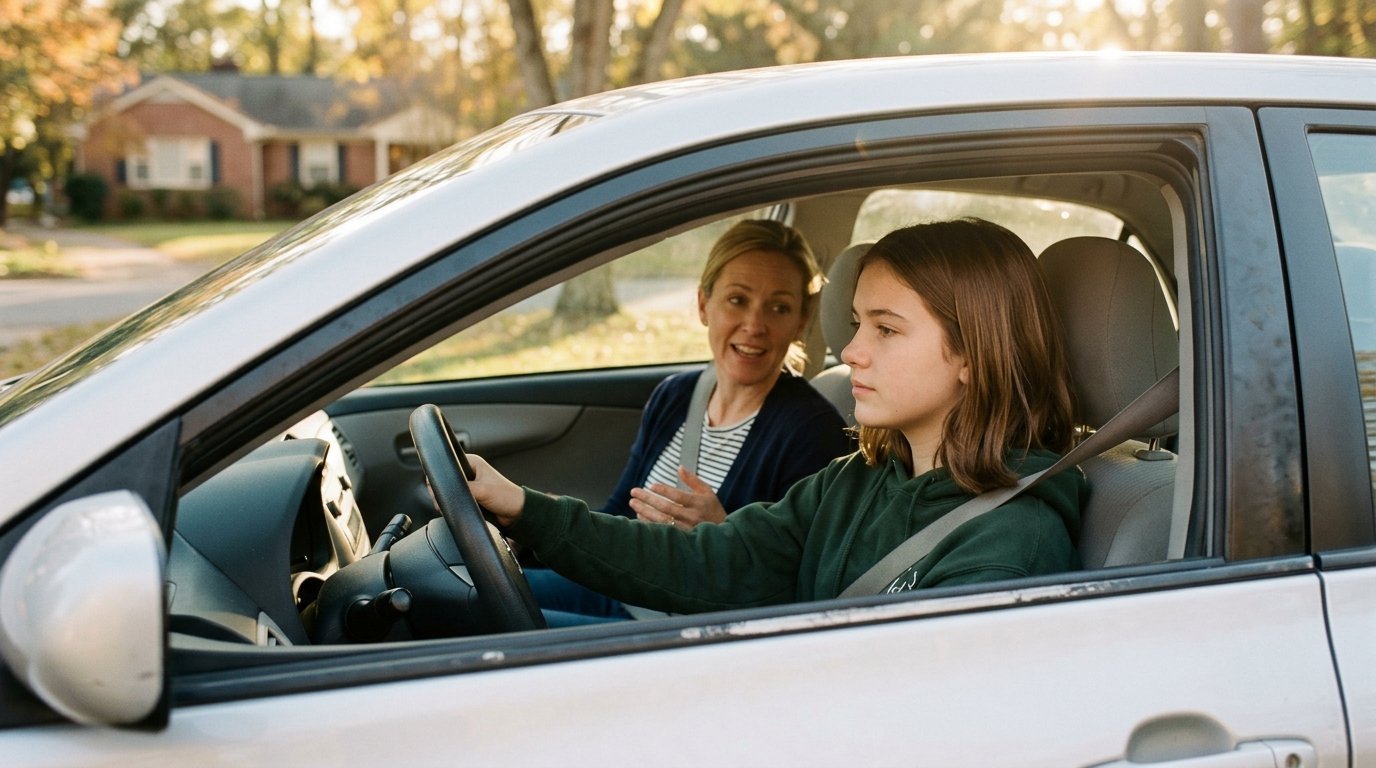
My kid passed the knowledge test, walked out of the DVS office grinning, and asked for the car keys before we even got back to the car. I said no, obviously.
Then I got home and realized I had no idea what any of this did to our car insurance. Do permit drivers even need to be on the policy? Is the bill about to double? I had plenty of questions and very few answers, and the forums I found mostly contradicted each other, usually with a lot of confidence.
So I started with Dave Roy Insurance Agency, an Allstate office on Stone Creek Drive whose auto page lists adding a teen driver as one of the moments to sit down with an insurance agent in Chanhassen and go over the policy, and the link will pull them up if you want to read it for yourself. That pushed me to treat this as a real review of our coverage instead of a quick phone call to add a name.
Here’s what I learned, in roughly the order I wish I’d known it.
What Minnesota expects before the keys change hands
Minnesota runs a graduated licensing system, and it shapes the insurance side more than I expected. Your teen doesn’t jump from zero to full driver in one step, and the policy questions shift a little at each stage. Knowing which stage you’re in tells you which questions to ask first.
Permit drivers and the household policy
With an instruction permit, a teen can only drive with a licensed adult in the passenger seat. Some insurers want permit drivers listed on the policy right away, and others don’t require it until the provisional license arrives. The only way to know which camp your carrier is in is to ask, and I’d ask before the first practice drive rather than after.
Either way, the permit driver is generally covered as a household member while driving your car. That’s reassuring, but it’s also the reason to confirm your liability limits early, since a new driver’s first fender bender gets paid out of your policy and not some separate one.
The provisional license and its limits
Once a teen has held the permit long enough and logged the required supervised hours, they can test for a provisional license. The first stretch of that license comes with passenger restrictions and a driving curfew, and both loosen as the teen builds a clean record. Minnesota DVS spells out the exact rules, and they’re worth reading together at the kitchen table.
This is the point where most insurers expect the teen listed as a driver on the policy. Don’t wait for renewal to fix it. If something happens while an unlisted licensed driver is behind the wheel, you’d much rather be explaining a premium change than a claim question.
How the policy actually changes
This was the part I’d been dreading. Honestly, it was less mysterious than I thought once I understood what the insurer is pricing.
Listed driver or separate policy
Most families add the teen to the existing household policy. It’s usually simpler, and the teen shares the household’s discounts and history rather than starting from scratch on their own. A separate policy for the teen tends to make sense only in unusual cases, like a car titled in the teen’s name, and even then I’d ask an agent to price both ways before deciding.
Which car they drive matters more than you’d think
When there are several cars in the household, insurers handle the question of who drives what in different ways. Some assign the teen to a specific vehicle, while others rate based on the household as a whole. That difference can swing the number more than any discount, so it’s the first thing I’d ask about.
If you have an older sedan and a newer SUV, it’s worth asking how the assignment works and whether the choice of car affects the price. I found this one surprising. An older, plain car often costs less to insure for a new driver than the shiny one, and it hurts a lot less when the bumper meets a mailbox.
When your teen leaves home for school
If your kid heads off to a college far from home and leaves the car behind, tell your insurer. Many carriers offer a distant student discount for exactly that situation, and the teen generally stays covered when they drive the family car on visits home. The details differ by carrier, including how far away the school has to be, so get the rules in writing rather than relying on a phone conversation.
That one caught me off guard, because nobody mentioned it during the first round of paperwork. An insurance agent who knows the household can flag it, but you have to tell them the kid is moving out first.
Coverage limits worth a second look
Minnesota is a no-fault state, so every auto policy has to carry personal injury protection and liability coverage, along with uninsured and underinsured motorist protection. The state minimums are a floor, and for a family with a house and some savings they’re a pretty low floor.
A new driver in the house is a good reason to look at whether your liability limits still fit. Some families add an umbrella policy at this stage, since it sits on top of both the auto and home liability limits. It’s one of the few add-ons I priced that felt like a clear yes.
Bringing the premium down without gutting coverage
Okay, so the premium goes up. That part isn’t news. The real question is how to keep the increase reasonable without cutting coverage you’ll regret cutting, because dropping collision or slashing liability to save a few dollars is exactly backwards with an inexperienced driver in the house.
Grades, courses and the usual discounts
Many insurers offer a good student discount for teens who keep their grades up, and some give credit for completing driver education. Bundling home and auto under one agency is another common way households soften the hit, and the agency’s site mentions bundling as something it can review with customers.
Ask what’s available instead of assuming. Discount names and requirements vary a lot from one carrier to the next, and nobody applies them automatically. I found two we qualified for just by asking, which paid for the time it took to make the list.
Phone-based driving programs
This one intrigued me. Allstate’s Drivewise program is optional and runs from your phone, and according to the agency’s auto page you control which trips are measured, with 50 trips required per policy period.
For a teen, a program like this does double duty. It can affect what you pay, and it gives you a running picture of how your new driver is actually doing behind the wheel, which beats guessing from the passenger seat. My kid was less excited about that second part, for the record, and we had to agree up front on what I’d actually look at.
Questions I brought to the review
By the time I sat down for an actual coverage review, I had a list. Writing it out ahead of time made the conversation a lot shorter and a lot more useful.
Things to have on hand
Bring your current declarations page and the teen’s permit or license number, plus a quick note on which car they’ll drive most. If your teen finished driver education or has a decent report card, bring proof of that too, since either one might qualify for a discount and the agent can’t apply what they can’t see.
What to ask after a fender bender
Ask how a minor claim involving your teen would affect your rates, and whether your policy includes anything like claim forgiveness. Then ask what your collision deductible is and whether it still makes sense with a new driver in the mix. A higher deductible lowers the premium, but only if you could actually write that check after a scraped fender.
And ask the question I almost forgot. If your teen borrows a friend’s car, or a friend drives yours, whose insurance pays first? In most cases coverage follows the car, so the owner’s policy is the one on the hook first. That answer led to a pretty serious talk at our house about who gets to borrow the keys.